What Is a Carbon Fiber Tube Used For?
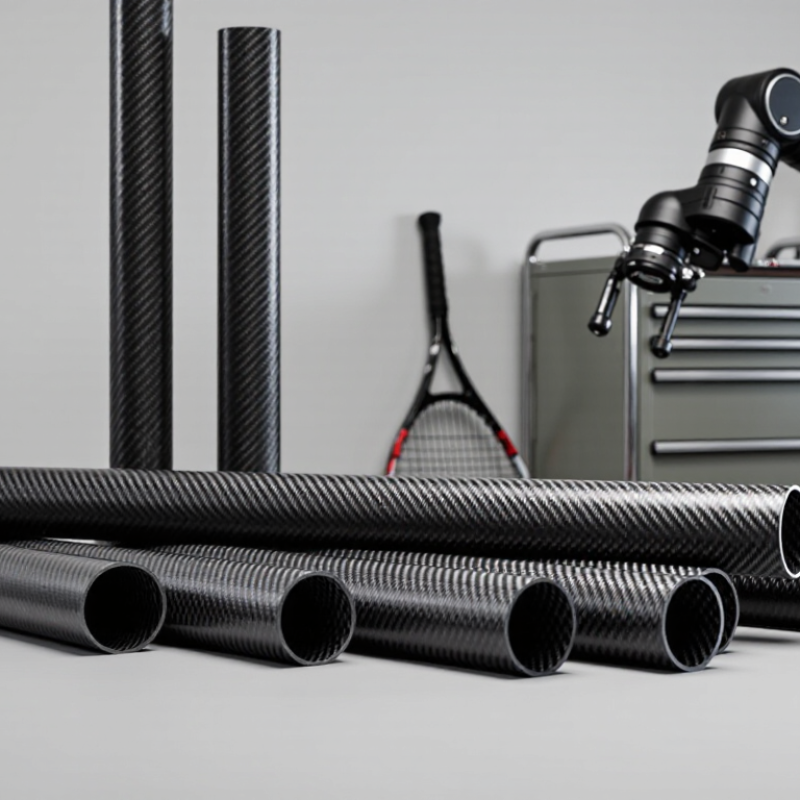
A carbon fiber tube is a hollow composite structure made from carbon fibers held in a resin matrix. Its low weight and useful stiffness make it valuable where bulky metal parts add unwanted mass. You can find tubes in camera supports, robotic arms, sporting equipment, lightweight frames, and some aerospace components. The exact role depends on the design, not just the material.
Picture a camera rig balanced on a tripod: a well-chosen tube can support equipment without making the setup difficult to carry. In a robot, a tube may form a moving arm, where reduced weight can help motors work more efficiently. These are practical advantages, but they are not guarantees. Not all carbon fiber tubes perform alike. Fiber direction, wall thickness, diameter, resin, and connection details can change how a tube handles bending, twisting, or impact.
That sounds simple. It isn’t. A tube can be stiff along one direction yet vulnerable to crushing, sharp impacts, or poorly designed joints. Metal may be a better choice for some loads, repair needs, or operating conditions. This article explains what carbon fiber tubes are used for, how their properties shape those uses, and what to consider when comparing options. The goal is a useful overview—not the claim that one material fits every project. A little caution matters. A light component still needs the right dimensions, testing, and support for its actual job.
Common Functions of Carbon Fiber Tubes
Carbon fiber tubes commonly act as structural supports, stiffeners, and shafts. They carry loads while keeping assemblies light, which is useful in camera tripods, industrial equipment, sporting goods, and aircraft structures. Their fibers can be aligned along the tube to favor stiffness in a chosen direction. That detail matters: a tube may resist bending well but perform poorly under loads it was not designed for. U.S. Department of Energy vehicle-lightweighting guidance reports that reducing vehicle weight by 10% can improve fuel economy by 6% to 8%. That figure describes whole-vehicle weight reduction, not a guaranteed result from adding carbon fiber tubes.
In practical use, tubes also help maintain alignment across long spans, such as support arms or instrument frames. Some serve as torque-transmitting shafts, but connections need careful design. Drilling or crushing the tube can damage its fibers, and metal fasteners may create stress concentrations. Lighter is not automatically better. The tube’s diameter, wall thickness, fiber direction, and joint design should match the actual loads; even experienced builders can underestimate impact damage.
Tips Check the manufacturer’s load data and inspect cut ends for fraying or cracks. Avoid clamping a tube directly in a hard vise; use padded jaws and spread the pressure. If the load is uncertain, test a sample assembly first.
How Carbon Fiber Tubes Strengthen Lightweight Structures
A carbon fiber tube strengthens a structure by placing stiff fibers around a hollow core. This geometry puts material far from the neutral axis, improving bending stiffness without the weight of a solid bar. On a camera boom, that can reduce sag while keeping the arm easier to reposition. Angled fiber layers can also help resist twisting. The details matter: fiber direction and wall thickness shape how the tube carries load.
The U.S. Department of Energy’s vehicle lightweighting guidance estimates that reducing vehicle mass by 10% can improve fuel economy by roughly 6–8%. DOE lightweight-materials assessments also cite potential component-weight savings approaching 50% when carbon-fiber composites replace steel, depending on design. These are benchmarks, not guarantees for every tube. Less mass. More reach. Yet joints, inserts, and local crushing can limit performance before the tube itself does.
Engineers match the layup to the job: a mast faces bending, while a drive shaft faces torsion. A drilled hole can start a split, and a bonded joint can loosen under repeated loading. That is the less glamorous detail. Testing for impact, fatigue, and temperature changes helps reveal weaknesses that stiffness measurements miss. Carbon fiber is not equally strong in every direction, and internal damage may be difficult to see.
What Is a Carbon Fiber Tube Used For?
Estimated mass of equal-sized tubes highlights how carbon fiber can strengthen lightweight structures without adding as much weight.
Illustrative estimates for tubes with a 30 mm outside diameter and 26 mm inside diameter: carbon fiber composite 0.282 kg/m, aluminum 0.475 kg/m, and steel 1.381 kg/m. Values use approximate material densities; actual composite tube mass and strength vary with the fiber layup and resin. Carbon fiber tubes are used in applications such as sporting goods, robotics, and aerospace structures where low weight and stiffness are important.
Aerospace, Automotive, and Marine Applications
What Is a Carbon Fiber Tube Used For?
Aerospace, Automotive, and Marine Applications
Carbon fiber tubes are useful when low weight and stiffness are important. Their fibers carry loads most effectively along their length, so tube design and fiber direction matter. A well-designed tube can help reduce structural weight without sacrificing rigidity.
In aerospace applications, tubes may support interior frames, instrument mounts, and lightweight structural assemblies. Engineers consider vibration, temperature changes, and how each tube connects to surrounding parts. A strong tube can still fail at a poorly designed joint. Weight matters.
Automotive designers use carbon fiber tubes in structural members, drive shafts, and components where reducing mass can improve handling or efficiency. In marine settings, tubes may serve as mast sections, supports, or lightweight parts exposed to salt spray. Carbon fiber itself resists corrosion, but metal fittings and joints may not. Not always. The material can also be costly to repair, and impact damage may be difficult to see beneath the surface. Choosing a tube means weighing its stiffness and weight against inspection needs, connection details, and the loads it will actually face.
Uses in Sports Equipment, Robotics, and Industry
A carbon fiber tube combines low weight with strong stiffness, making it useful wherever moving parts must stay light and stable. In sports equipment, tubes appear in bicycle frames, fishing rods, and paddle shafts. A lighter shaft can feel quicker in the hand, while stiffness helps limit flex under load. Every gram matters. Yet a tube’s performance depends on its wall thickness, fiber direction, and joints—not just the material name.
Robotics puts those properties to practical work. The International Federation of Robotics reported 541,302 industrial robot installations worldwide in 2023 in World Robotics 2024. Lightweight carbon fiber links and support tubes can reduce moving mass, helping a robot accelerate with less effort. But stiffness has limits. A sharp impact or poorly designed clamp can damage a tube, sometimes without an obvious surface mark. In industry, tubes also serve in inspection equipment, automation fixtures, and lightweight structural supports, where corrosion resistance and easy handling can matter.
Grand View Research estimated the global carbon fiber market at USD 6.3 billion in 2023 and projected an 11.0% compound annual growth rate from 2024 to 2030. That figure covers carbon fiber broadly, not carbon fiber tubes alone. It signals wider material demand, but does not prove every application benefits. Engineers still need to check load direction, temperature, joining method, and repair needs before choosing a tube.
How Tube Properties Shape Their Applications
Carbon fiber tubes suit jobs where low mass and directional stiffness matter. Their fibers carry loads most effectively along the tube, so they work well in robotic arms, camera supports, bicycle components, and aircraft structures. A thin tube can feel remarkably rigid in your hand. Yet stiffness is not the whole story: wall thickness, fiber orientation, tube diameter, and joint design all affect performance. Carbon composites can also hide impact damage beneath a clean surface.
The U.S. Department of Energy’s 2013 Lightweight Materials for Cars and Trucks report states that carbon-fiber composites can be up to 50% lighter than steel. That comparison is not a guaranteed tube-level weight saving; the full design matters. In a long support pole, a larger diameter may improve bending stiffness without adding much material. Under compression, however, a slender tube can buckle, even when its fibers have high tensile strength. A tidy specification can still miss the real failure mode.
Tips: Check load direction, wall thickness, and end fittings before choosing a tube. Look for test data on bending, compression, and impact—not just tensile strength. If the tube will see knocks, inspect it regularly; damage may not announce itself.